

The Garden Party Collective presents: "Nature As It Is: Poems of Queer Ecology"


Congratulations to our three winners for our sixth poetry contest (June 2026):
-
Jerald Lim
-
Isaac Salazar
-
Fiona Martinez
“suppose we reclaim a singaporean nature poem”
after "unnamed dragonfly species" by juliana spahr
before (the eviction of the mangrove forest, the
supposed dog-eating catfish, the striped tiger fish, mouth-brooding arowana,
the wolf barb, and the salmon carp) — these were
supposedly once (wetlands). there is a street in the middle
of the central business district in singapore called beach road
emblazoned on a state-sanctioned signpost
(once mushroom-dotted nudibranch tended to electric blue
sponge gardens, here)—street signs are often the clearest
markers of (an erased) history left intact
(as an act of arrogance)—which is estranged
a good kilometer or two away from any body of water
(and the montipora coral of many colors). no sand in sight; long gone
is (the memory of) any beach here. (diamondfish schools
fix the lunar cycle at full silver, cauliflower coral
hitchhike by way of tentacles, jelly sea squirts practice
monastic seclusion, and the maxi-mini carpet anemone,
and the oval sea grapes seaweed, and the clathria sponge, and the
leafy filefish, and the fan worm, and the cheesecake nudibranch,
and the anchor tuskfish, and the sandfish sea cucumber) yet
it(s) remains there (the burial
grounds) entombed (with sand (bloodied) from all across nusantara)
supposedly (the emerald deathrattle of coin green seaweed)
still beach.
in 1822, sir stamford raffles,
supposedly a patron of natural history, conducted
the first exorcism of sand to expand the british colonial empire (from the
supposed once singapore highlands) into uninhabited waters
(supposedly). they said
suppose land existing on (generational fishing) coasts (and no one
supposed this reclamation). and this rich legacy of
supposing has (heralded and) continued past
(supposed) national independence (when they sieved via sand barges
(supposedly they meaning independent contractors unaffiliated
with the singapore state (which only expropriates legally))
from the mekong in cambodia, around
supposed islands in indonesia
(now submerged), in vietnam, philippines,
( ), ( ), ( ), ( ), ...).
coming out of the lee kong chian natural history
museum, a lorry spasms as the driver disregards a speed bump. i
count a dozen migrant workers from
supposed once sites of land (plunder) crammed
into the back of its open top—
singapore is known for its strict
safety regulations (non-expat migrants are
supposedly exempted from consideration)—
en route to build
government homes for singaporeans
(supposedly non-migrants) atop their
supposed land.
the rafflesia is a parasitic plant named
after sir stamford raffles.
it grows on woody plants.
it does not have roots.
it does not have stems.
it does not have leaves.
it is also known as the corpse flower
for its rotting flesh smell.

Jerald Lim is a poet practicing in the bird bath where love letters, hypertext, and queer ecology meet. They are slowly but seditiously chipping away at dualisms and its offspring — anthropocentrism, colonialism, capitalism, and other forms of extractivism and violence. They enjoy hooping, musicking, and washing the dishes for friends. You may visit their corner of the internet at jeraldlim.com.
“Seahorse Pantoum”
Male seahorses are the only species on Earth where the male gets pregnant and gives birth.
If I could I would, so I will do my best & try
to make a man satisfy my mommy hungers.
Not only the idol of want, but the curse of it too,
beyond the point where wanting can still return.
To make a man satisfy my mommy hungers,
I study the seahorse, how it takes in what arrives
beyond the point where wanting can still return
& make it chamber, a patience gone mouth, gone thick.
I study the seahorse, how it takes in what arrives,
how the body opens not in conquest but in keeping,
& makes it chamber, a patience gone mouth, gone thick
no one praises it, no shine, no pretty for the taking.
How the body opens not in conquest but in keeping—
Is this what I mean by love?
No one praises it, no shine, no pretty for the taking,
this slow work, this glut of becoming a place for another.
Is this what I mean by love?
The wish to be entered not as wound but harbor?
This slow work, this glut of becoming a place for another
undoes the story I was given of men.
The wish to be entered not as wound but harbor—
If I could, I would say it, mouth-first & shameless.
Undo the story I was given of men:
that to receive is to fail & that to carry is to yield.
If I could, I would say it, mouth-first & shameless:
Not only the idol of want, but the curse of it too—
that to receive is to fail & that to carry is to yield.
If I could I would, so I will do my best & try.
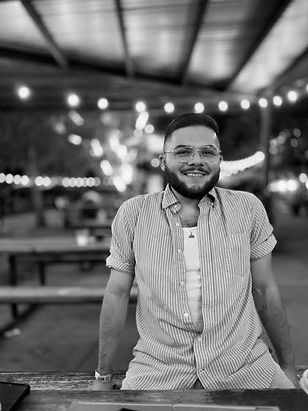
Isaac Salazar is an Austin-born and Houston-based poet. A winner of the 2025 Michelle Boisseau Poetry Prize, his poems have been published or forthcoming in AGNI, Bear Review, Hayden's Ferry, Tinderbox Poetry Journal, West Trade Review, and West Branch, among others. He is a graduate student at Rice University.
"To the animal approaching ocean"
An animal in between pleasure and hunger. Hunger itself sometimes a kind of pleasure.
– Ross Gay, Book of Delights
Come as shell.
Come as seed.
Come bury yourself in sand.
Come spare, rare, and raw.
Come breathe the swelling suite of sea.
Come blue as air trails
a continuous path through you.
Come eaten.
Come as rind.
Come to be rendered.
Art doesn’t ask, but you become.
Come submissive.
Sand dresses you and rich in mica,
you gleam.
Come between forms.
Come monstrous.
Come with rage to burn and leave
a rash.
Leave a brined husk.
Leave your heart in the cave of your throat
under watch of uvula
blinking in the pink dark.

Fiona Martinez is a queer poet from Boise, Idaho and an MFA writing student at UC San Diego. Her hybrid work embodies the natural world (water, limbs, birds & ants) to queer the border between human and nonhuman beings, experiences of mixed identity, and the entanglement of violence and tenderness in our shared work towards liberation. Fiona’s work can be found in the Washington State Queer Poetry Anthology, Alchemy Journal of Translation, Voicemail Poems, and Stonecoast Review.
Poetry Contest Details
For our sixth poetry contest (June 2026), Laura Villareal selected "Nature As It Is: Poems of Queer Ecology":
"Queer ecology (which is really just ecology) disrupts presumptions of binary thinking at every turn. Heteronormativity and dualism aren’t the norm in the abundant and radically inclusive reality of nature. The more-than-human world is brimming with queerness and continues to challenge human-imposed limitations on our understanding of sex, gender, and sexuality. Give me your poems about many gendered mushrooms, send me your pantoums about male seahorses giving birth, villanelles about sex-changing clownfish and ginko trees, and sonnets for queer creatures (flora, fauna, and funga). Whatever form, whatever part of nature calls to you. Let’s return together to the truth about our world, overflowing with queerness—nature as it is. Surprise me."
congratulations to our finalists!
